Vintage film, VHS and datamosh looks in After Effects: twenty eras in one effect
DISKO Decades makes footage look like it came from another era. It's one effect for After Effects and Premiere Pro with twenty looks in it, from an 1850s wet plate and a hand-cranked silent film to 8mm, VHS, a flip phone and a cracked LCD. Pick a look and your shot comes out as if it had been through that gear.
The problem: an era is more than a color
An old-film LUT gets you the color and stops there. What makes 8mm read as 8mm is everything else that happened to the picture: a camera running at 18 frames a second, chunky grain, a gate that won't hold still, the sprocket hole wandering into view, light leaking in at the end of the reel. VHS is no different. The color smears to the right, the edges ring, a tracking band rolls through now and then, and the deck prints PLAY over all of it.
You can build that by hand. It takes a dozen effects and some stock overlays, and six months later nobody wants to open that precomp, including you.
How Decades works
Each look is a chain of stages, run in the order the real thing happened: the camera's frame rate, the lens, the process's color, grain and halation, damage, then whatever came next for that era, whether that's a video camera and its codec, a tape, a projector, a printing press or a picture tube. Borders and on-screen text go on last.
Most of the time you won't touch any of that. Every look answers to the same few macro controls: Grain, Wear, Color, Instability, Frame Rate, Tone and Borders & Text, plus Amount and Mix. When you want to go further, Load into Custom Controls copies the look into the full set and every stage is yours to change.
The twenty looks
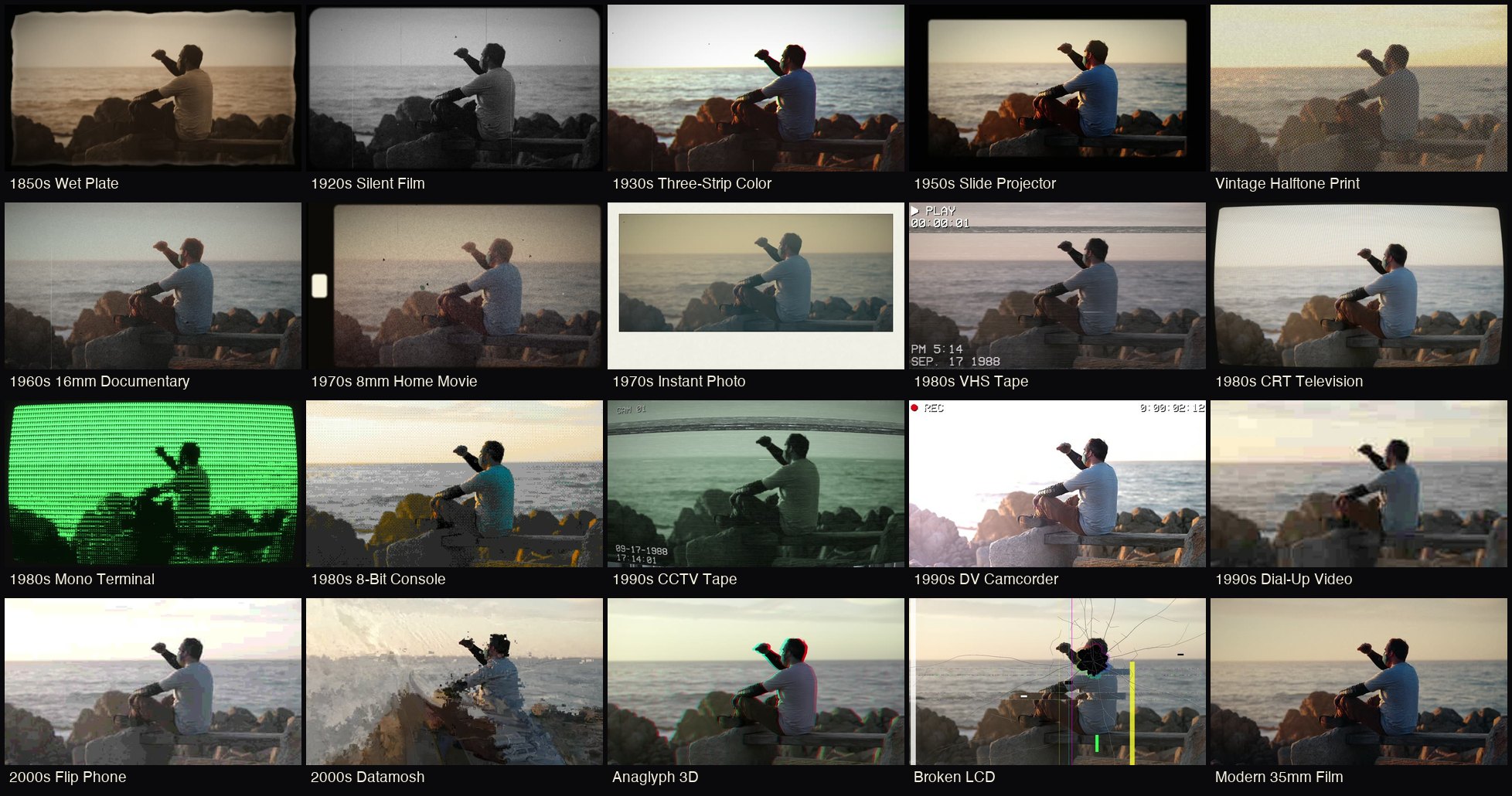
- 1850s Wet Plate: blue-sensitive, long exposures that ghost anything moving, poured edges and drain marks.
- 1920s Silent Film: a hand-cranked camera at 16 uneven frames a second, flicker, dust, hairs and running scratches.
- 1930s Three-Strip Color: saturated primaries from three separation records, printed a hair out of register.
- 1950s Slide Projector: steep, saturated reversal film, the lamp's hotspot and a mount around the picture.
- Vintage Halftone Print: four plates of coarse dots at their own angles, out of register, on newsprint.
- 1960s 16mm Documentary: a neutral print, organic grain, red halation round the lights.
- 1970s 8mm Home Movie: 18 frames a second, warm and faded, the sprocket hole in view, burning out at the ends of the reel.
- 1970s Instant Photo: milky shadows in a white card frame. Animate Develop and it appears.
- 1980s VHS Tape: smeared color, ringing edges, the head-switch strip, PLAY with a counter and date.
- 1980s CRT Television: the beam drawn line by line through an aperture grille, behind curved glass in its bezel.
- 1980s Mono Terminal: the picture as glowing green text, the phosphor slow to fade.
- 1980s 8-Bit Console: 224 lines of chunky pixels in a fixed palette, with ordered dither.
- 1990s CCTV Tape: six frames a second on a looped tape, camera number and time burned in.
- 1990s DV Camcorder: sharpened hard, highlights blown flat, interlaced, REC and timecode in the viewfinder.
- 1990s Dial-Up Video: a postage stamp blown up into macroblocks, with frames dropped along the way.
- 2000s Flip Phone: skew and jello on every move, muddy color, fifteen frames a second.
- 2000s Datamosh: more on this one below.
- Anaglyph 3D: red and cyan, pushed apart hard, bright things nearest.
- Broken LCD: shattered glass from an Impact Point, black ink spreading, columns stuck in neon, a leaking backlight.
- Modern 35mm Film: warm print stock, fine grain, a whisper of halation, nothing broken.
The datamosh is a real one
A lot of mosh looks are a smear with good intentions. Decades does what the corrupted file did. At a cut, the new shot's keyframe is lost: the old shot's last picture holds, and each frame after it moves that picture along the new shot's block motion vectors, worked out on the CPU the way a codec does. Blocks the motion can't explain get drawn fresh.
It fires at cuts, at the layer's start, or wherever you keyframe the Mosh checkbox on, and Mosh Length sets how long it lasts. A frame in the middle of a mosh renders the same whether it's read in order or on its own, so scrubbing, the render queue and Multi-Frame Rendering all agree.
The controls
- Look: the twenty, plus Custom.
- Amount and Mix: how much of the look, and how much of the original to keep.
- Grain, Wear, Color and Instability: the macros every look answers to.
- Frame Rate: the look's own, the footage's, or 6 to 24 frames a second.
- Tone: the look's own, or sepia, silver, amber, green, blue, warm or cool.
- Borders & Text: the film edges, mounts, frames and on-screen display.
- Random Seed: every render matches, until you ask for a different one.
- Timing & Text: film burns, Develop, the counter and date, Camera Number, Mosh At, Mosh Length, Impact Point and Break Time.
Good for
- Flashbacks and period sequences
- Found-footage scenes and security-camera shots
- Music videos and title sequences
- Fake archive inserts in a documentary
- Something on a TV or a phone in the background of a shot
Also new on the shelf
Four other disks got updates in the same release, all free for anyone on 1.x. Projects you've already saved open and render as they did: everything new is off, or set to the old look, until you ask for it.
- Typetrace 1.9: Ink Bleed. The pen lays a thin line and wet ink wicks out from it through the paper.
- Inferno 1.1: liquid flames. The shape burns to a dark core with bright rims, and stringy flames rise off it.
- Glitch 1.3: pixel sort, pixel stretch, a channel wave, ordered dither and Minimax, with eight new recipes for 52 in all.
- Balance 1.2: Deflicker for pulsing lights, stepping timelapses and LED bands, and grading to a 24-patch color chart in shot.
Requirements and price
After Effects 2024 or later and Premiere Pro 2024 or later, on macOS 12 or later (Apple silicon and Intel) or Windows 10 or 11, 64-bit. Windows is a beta for now, so tell us at support@disko.media if anything misbehaves. There's no GPU requirement; Decades runs on the CPU. It works in 8, 16 and 32 bpc.
Decades is $7.99 on its own, or it comes with the DISKO Motion V1 box set for $59.99. You pay once, and license codes work offline. If you already own the box set, you already own this: install it and your code takes the watermark off. The trial is the full effect, and renders carry a watermark until you enter a code.
Time travel, minus the paradoxes.
DISKO Motion
A suite of effects for After Effects and Premiere Pro
Browse the Motion aisle The box set for $59.99 All apps